
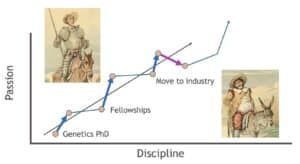
As a senior leader at a biopharma company, I am often asked to speak to young professionals about careers in healthcare and, specifically, my career journey. I love these opportunities to chat with people earlier in their careers – not because I hold the keys to success or can share a step-by-step playbook, but because I think it’s important for leaders to speak openly about their journeys, highs and lows included.
One of the most important learnings I share is this: career development is not a steady, uninterrupted ascent, or even a predictable one. It’s a jagged line, with ups and downs, a mix of achievements and setbacks.
I learned this lesson in 2017 – the hard way.
I had spent four years at my first job in biopharma building something I genuinely believed in: a vision that causal human biology coupled with the right therapeutic modality and a clear path to clinical proof-of-concept could fundamentally change how new medicines are invented. We were making good progress as a team, and I was growing as a leader. Or so I thought.
Unfortunately, the organization wanted a new direction in leadership. I found myself out of a job.
Over the course of several months, I replayed events in my head; I confided with a very small group of family, friends, and advisors; and I reflected on advice I had heard over the years about perseverance and failure.
What I have learned since that time is that the stories we tell about our careers are often retroactive fictions, polished into coherence long after the confusion of living them. Rather than a straight ascent, career progression generally follows a jagged line, with lateral moves and possibly even steps back to move in a new direction and learn new skills. And in 2017, I learned that sometimes career progression decisions are out of your control.
While I have explored the concepts of failure and advice to my younger self in previous blogs, there is something those earlier pieces did not quite reach. This post is about something different – and, I think, something harder. It is about what it takes to keep going before the story makes sense. It is about the natural tension between imagination and the persistence required when the path is not clear. It is about listening to two distinct voices simultaneously – passion and discipline – and deciding how to weigh each in navigating a path forward.
It is this tension that makes the line jagged, but it’s also what distinguishes a true leader. This is the story young professionals need to hear – not a polished playbook, but an unvarnished look at the choices we make and the moments that both inspire and shape us.
To tell that story here, I want to start not with a leadership textbook or my own personal history, but with a novel. The first modern novel, some would say. And one with more leadership lessons than I’ve found in any textbook.
James March and the Knight of La Mancha
I began writing this blog post while visiting our BMS Research site in Sevilla, Spain. Walking along Guadalquivir River, I was reminded of Don Quixote – the idealist who chased impossible dreams. Knowing that I would be giving presentations to student groups over the following weeks, my first instinct was predictable: Isn’t this the best advice I can give students? Find your passion and follow it?
But as I explored that instinct further, I came across James March, a professor at Stanford Graduate School of Business. What stopped me was this: March had spent decades arguing that the most important lessons about leadership could not be found in case studies or frameworks, but in literature: in Tolstoy, in Shakespeare, and most memorably, in Miguel de Cervantes’s novel about Don Quixote. What I had always read as satire – Quixote, a deluded man tilting at windmills – March read as a leadership manual.
March even created a film on the topic, Passion and Discipline: Don Quixote’s Lessons for Leadership. The cinematography is dated by today’s standards (though I enjoyed watching March stroll through olive groves holding a glass of wine while narrating the virtues of Quixote!), but the one-hour film is remarkably informative. In it, March made a claim that struck me as radical: that Don Quixote, the battered, windmill-tilting knight of La Mancha, is a model for the kind of leadership our world urgently needs.
The conventional reading of Don Quixote frames it as a comedy of self-delusion: a man who charges around Spain mistaking sheep for armies, inns for castles, and windmills for giants. He is, by any rational measure, wrong about almost everything. He fails repeatedly. He is laughed at. He is beaten. He returns home, dejected, again and again.
And yet he continues to dream. And he persists.
Why? Quixote does not persist because he expects to succeed. He persists because of who he is. He acts from vision, from imagination, from a deep and unshakeable sense of self.
March’s insight is profound precisely because it runs against the grain of almost everything we are taught about rational decision-making. We are told: calculate the expected value. Weigh the risks. Build a portfolio. Place bets you can afford to lose. All of this is sensible advice. All of it would have kept Don Quixote safely at home.
And none of it, on its own, would have ever changed the world.
Quixote and Panza: The Two Voices in Every Leader
Here is what makes Cervantes’ novel richer than any parable: Quixote does not travel alone.
Sancho Panza – his pragmatic, deeply loyal squire – is in many ways the opposite of Quixote. Where Quixote sees giants, Panza sees windmills. Where Quixote charges forward, Panza hesitates, calculates, worries. Where Quixote is animated by vision, Panza is animated by consequences: the rewards that might come from loyal service, and the very real bruises they accumulate along the way.
Panza is not a fool. On the contrary, he is often the wisest voice in the room – a superb pragmatist, an excellent reader of immediate circumstances, and a genuine friend. When Quixote’s visions spiral into dangerous fantasy, it is Panza who anchors them – sometimes literally – to the ground.
Panza’s practicality introduces a natural tension into Quixote’s imagination, pulling what would have been a straight line toward a future vision into the more realistic jagged line, with its fits and starts.
The easy interpretation is that Quixote and Panza represent dreamer and realist. But the deeper reading is more interesting: both voices live inside every serious leader. The Quixote voice is the one that looks at a nearly intractable problem and says, with passion: this is worth my life. The Panza voice is the one that layers discipline: yes, but how? What resources do we have? What are we actually doing today?
Vision without execution is madness. Execution without vision is just activity.
This is what I mean by “natural tension” – the differing perspectives of Quixote (passion) and Panza (discipline). The push and the pull create the jagged line.
I feel this duality acutely. When I was building the concept of genetics-guided drug discovery during my academic years, my Panza voice was loudest, cataloguing the failure rates of genetics-to-drug pipelines, enumerating the reasons the idea was premature, asking whether this was a responsible use of a lab’s resources. My Quixote voice kept insisting that the question was too important to abandon. The tension between those two inner voices – not the resolution of one over the other, but the sustained holding of both – is where my best thinking happened.
The leader who can see giants and windmills simultaneously is rare. And that capacity, I have come to believe, is not given at birth. It is forged, slowly, along a jagged line. Passion and discipline.
Before I say more about how I know this, I want to offer one honest caution. The stories we tell about navigating that tension – including the ones I am about to tell – have a way of making the jagged line look smoother than it was. I will return to this danger. For now, here are three jagged lines from my own career.
My Own Jagged Lines
When I look at the arc of my career, I can construct a clean narrative: a physician-scientist trained in human genetics, who pursued academic work in rheumatology and immunology, then made a move to industry to accelerate drug discovery, and is now leading Research at BMS. It sounds almost orderly in retrospect.
It was not.
The first jagged line came when I deviated from my original path to become an orthopedic surgeon. During medical school, I took a year off to do a Howard Hughes Research Fellowship in the lab of Hunt Willard at Case Western Reserve University. I will be honest about my original motivation: it was a calculated CV-builder, nothing more. I did not expect the year to change me.
It did. I fell in love with genetics research. One year became four, and then an entire career. What began as a tactical detour became the defining commitment of my professional life.
The lesson is one that is genuinely difficult to act on: we resist reconsidering our paths because rethinking feels like self-betrayal. To change direction is to admit that what once seemed right may no longer be. Steve Jobs famously said: “Don’t be trapped by dogma, which is living with the results of other people’s thinking.”
At the time, my Panza voice was loudest, cataloguing the years already invested in medicine, the expectations of others, the risk of starting over. Fortunately, my Quixote voice gained strength.
I changed from surgeon to geneticist. It may not sound like a dramatic pivot. Trust me: it was massive.
The second jagged line occurred during my academic faculty years. I had organized my lab around three pillars: genetic discovery, functional interrogation, and embedded genomics. Each was intellectually engaging but somewhat disconnected. Over time, I found that these pillars were converging toward something I could not yet fully see: a unifying vision in which human genetics would not just describe disease but would actually guide drug discovery.
That convergence did not happen all at once. It happened when I began asking a simple question: What does it mean for a therapeutic target to be genetically validated? I was surprised by the variety and inconsistency of the answers.
That is when I knew I was onto something important. With the help of mentors David Altshuler and Ed Scolnick, I began building out the concept of genetics and drug discovery, a problem that felt worthy of Edwin Land’s counsel: “Work only on problems that are manifestly important and seem nearly impossible to solve.”
My Quixote voice took charge. The problems that are manifestly important and nearly impossible are, by definition, the ones where windmill-seers will tell you to stop. They will show you the data on failure rates. They will point to the graveyard of abandoned programs. They will ask, reasonably and correctly, whether this is a good use of your time.
They are not wrong. They are Sancho Panza. And you need them.
But if you only listen to Panza, you never leave home.
I listened to my Quixote voice, the one that says this is worth my life, while not silencing my Panza voice, the one that asks how, exactly? When I held both, I realized that the question I most wanted to answer could only be answered at scale in industry. Academic labs do not run large discovery programs or global clinical trials. The only place to test the hypothesis properly was inside a drug company.
That was my windmill moment. Instead of windmills, I saw giants. And I decided to leave my academic home.
The third jagged line was not one I chose — and it was the most painful.
I was leading Translational Medicine at a biopharma company, four years out from academia, when an organizational restructuring ended my role. I had made mistakes along the way. Managing people and teams at scale was challenging; the diversity of science and functions was immense; and my learning curve had been steep. But I believed I was contributing meaningfully. However, when the organization reenvisioned its future, I was not a part of it. I was asked to leave.
This was, without exaggeration, one of the most difficult periods of my professional life. I was Quixote thrown from his horse, trampled in the road, looking up at the sky wondering whether the quest had been a delusion all along.
What kept me from concluding that it had? Not a spreadsheet of options. Not a leadership book on career choices. What kept me going was a stubborn belief that the why – using human genetics to make drug discovery smarter and more humane – was still worth pursuing, even if the how had just been violently rearranged.
My family steadied me. A small group of advisors helped me see the path forward. And I forced myself, in the hardest weeks, to separate the question Is the mission still worth it? from the question Did this particular role fail? Those are different questions. Conflating them is how a jagged line becomes a permanent stop.
Soon I found a new role at Celgene under my mentor, Rupert Vessey. When I tell that transition story in polished settings, I say: I wanted oversight of drug discovery and early development. I wanted to return to my immunology and rheumatology roots. I wanted the urgency of a smaller company. All of that is true. But the jagged line tells a more honest story.
My lesson: some jagged lines are ones you create. Others are forced upon you. If the latter, do not lose faith. Believe in yourself, even when others do not. Persevere.
The Danger of the Clean Story
I want to pause here, because I am aware of the irony of what I have just done.
I told you three stories that all, in the end, turned out OK. The surgical pivot led to a career in genetics. The academic convergence led to a transformative idea. The painful departure from one biopharma company led to another, and then to BMS. Don Quixote himself would recognize this as self-mythology: the retroactive smoothing of a jagged line into something that looks, if not straight, at least purposeful.
Here is the tension I cannot resolve for you: vision requires narrative. You cannot motivate yourself – or anyone else – without a story about where you are going and why it matters. Quixote’s genius, in March’s reading, is precisely that he has a story so deep and so personal that no amount of evidence can shake it. That narrative persistence is what allows him to keep going after every humiliation, every windmill, every night spent bruised by the side of the road.
But that same narrative rigidity can become a cage. It can cause you to ignore evidence that you are wrong. It can prevent the kind of productive adaptation that a jagged line requires. It can turn vision into dogma and silence the Panza voice precisely when you need it most.
I cannot tell you how to hold both at once. I can only tell you that the attempt is the work. And it is a worthwhile struggle to balance both voices.
Hold Your Why Tightly, and Your How Loosely
The resolution I have arrived at – provisional, tested, still subject to revision – is this: hold your why tightly and your how loosely.
The Quixote vision – the commitment to working on problems that are manifestly important and nearly impossible to solve – should be the stable core. That is your why. Protect it. When you are thrown from your horse and lying in the road, it is the only thing that will get you back on.
The specific path toward that vision must remain genuinely open. That is your how. The particular role, company, discipline, or method must be held lightly enough that you can revise it without feeling that your identity has collapsed.
In practice, this means asking a single orienting question when the path zigs unexpectedly: Does this new direction still serve the why? If yes, even if the how looks nothing like you planned, keep riding. If no, then it is worth stopping, regardless of the sunk costs.
Your why might be: I want to work on problems where science can directly change patients’ lives. Your how – which lab, which company, which role, which disease – must remain genuinely open. When the path zigs, ask only whether it still serves the why. If it does, the jagged line is not a failure. It is the route.
Still Tilting at Windmills
Several months after my walk in Sevilla, I gave career talks at Penn’s Life Sciences & Management course and at the Yale Biotech Club’s Life Sciences Career Fair (link to slides here). As I engaged with students, I was reminded of the uncertainty I felt early in my career. I was reminded that most students were at the beginning of their own jagged lines, and I tried to reinforce that the jagged line starts the moment you care about something enough to pursue it.
I have spent a career in medicine and science, working on problems I believe are among the most important in human biology: whether human genetics can make drug discovery smarter and more humane; why immune systems attack their own hosts, and whether we can invent medicines to reset immune memory; and what guiding principles might make drug R&D more efficient and less expensive.
Some of what I have charged at full tilt turned out to be windmills. Not all of those pursuits ended well.
Some of the windmills turned out to be giants after all.
I am still tilting. The field of human genetics-guided drug discovery – the quest I chose over a decade ago, the vision that survived multiple biopharma companies, and every bruised night along the way – is now transforming how medicines are made. Programs that began as “manifestly important and nearly impossible” are now producing drugs that help patients. That arc has not been straight. It has been magnificently, frustratingly, and educationally jagged.
James March was right. Don Quixote was right. The line was never going to run straight. And I would not have had it any other way.
So this is the advice I give young professionals: Don’t be afraid of the jagged line. Be afraid of the person who never got off the straight one, because that person never had to grow. The detours are not failures, even if they feel that way. They are the data. They are the curriculum. They are your career.
The best careers do not run straight because the best questions do not have straight answers. They are not found by walking the obvious path. They are found by having the vision to see giants where others see windmills, the imagination to believe the quest is worth taking, and the persistence – in spite of every imaginable challenge – to keep riding.