Last month, retired U.S. soccer champion Abby Wambach visited Bristol Myers Squibb for our People Week keynote event. She told us that her speaking career began shortly after she retired, when she was asked to give a commencement speech at Barnard College.
She then gave all of us some homework: go write your own commencement speech, even if you’ll never give it. Why? Because writing a commencement speech will crystallize for you what you believe, what you know, and how you came to believe and know those things.
I’ve written a few things on this blog that could loosely qualify as a commencement speech (see here and here). So instead of another, I wanted to riff on an idea I recently heard at my daughter’s high school commencement – with a lesson on leadership and a call to action at the end.
Cam Lynch spoke at the Wellesley High School graduation (link to his speech here, local media coverage here). He challenged his fellow graduating seniors to “Be Chalant.” The core message: kids try to be too cool, nonchalant. He asked the audience matter-of-factly, “Why?” He highlighted Ted Lasso as a role model and leader – a character whose personality is the opposite of “nonchalant.”…
Read full article...
As a senior leader at a biopharma company, I am often asked to speak to young professionals about careers in healthcare and, specifically, my career journey. I love these opportunities to chat with people earlier in their careers – not because I hold the keys to success or can share a step-by-step playbook, but because I think it’s important for leaders to speak openly about their journeys, highs and lows included.
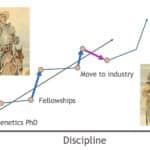
One of the most important learnings I share is this: career development is not a steady, uninterrupted ascent, or even a predictable one. It’s a jagged line, with ups and downs, a mix of achievements and setbacks.
I learned this lesson in 2017 – the hard way.
I had spent four years at my first job in biopharma building something I genuinely believed in: a vision that causal human biology coupled with the right therapeutic modality and a clear path to clinical proof-of-concept could fundamentally change how new medicines are invented. We were making good progress as a team, and I was growing as a leader. Or so I thought.
Unfortunately, the organization wanted a new direction in leadership. I found myself out of a job.
Over the course of several months, I replayed events in my head; I confided with a very small group of family, friends, and advisors; and I reflected on advice I had heard over the years about perseverance and failure.…
Read full article...